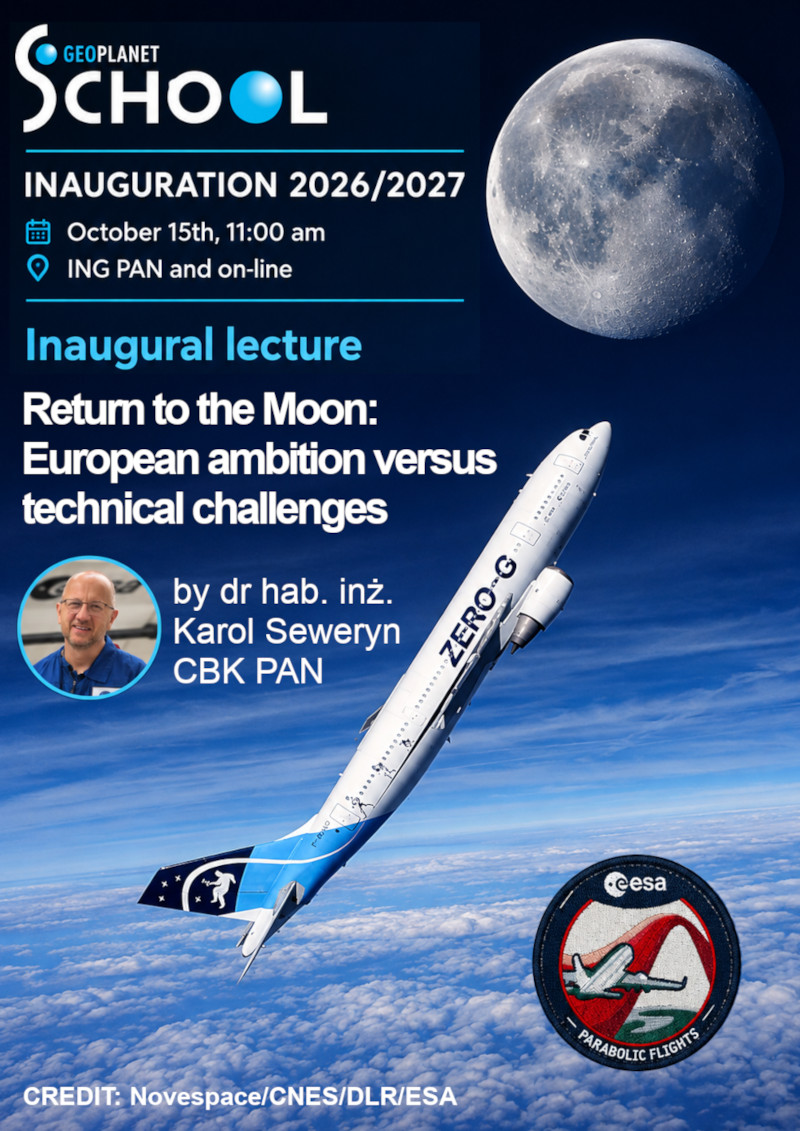
The inaugural lecture of the 2026/2027 academic year, titled “Return to the Moon: European ambition versus technical challenges“ will be given by dr hab. Karol Seweryn (Space Research Center of the Polish Academy of Sciences). The inauguration of the academic year will take place on October 15th, 2026 at 11 a.m., at the Institute of Geological Sciences, Polish Academy of Sciences (ING PAN) and online (hybrid event).
Preparations for a permanent human presence on the Moon are becoming more realistic and will occur within the next decade. Key space agencies have their own plans such as: the Artemis missions established by NASA, the Terrae Novae 2030 strategy developed by the European Space Agency (ESA), or the Chinese Chang’e program. The establishment of a Moon settlement will require a significant civil engineering and mining endeavour aligned with In situ resource utilization (ISRU) paradigm.
Lunar operations present unique challenges that significantly differ from those on Earth, due to the non-trivial influence of gravity (lower than on Earth), limited mass and power budgets for payloads, extreme temperatures, high vacuum and electromagnetically charged regolith and dust.
In the talk, I present the status of ESA efforts connected with exploration of the Moon and as an technological example details of regolith sampling and excavation process occuring in low gravity lunar environment. This process was analysed in a recent PETER-PFC experiment conducted during the 88th ESA parabolic flight campaign, which simulated lunar gravity. Within the framework of the PETER-PFC experiment, three tests were carried out: (i) digging tests with the Rotary Clamshell Excavator (RCE), a novel sampling device equipped with a cylindrical shovel rotating about its axis of curvature, which repeatedly collected soil samples, (ii) blade cutting tests to obtain mechanical shear parameters of the soil, and (iii) rotating drum tests to measure soil dynamic angle of repose.
Karol Seweryn, Ph.D., Eng. Associate Professor at the Space Research Centre of the Polish Academy of Sciences, Warsaw, Poland as well as at AGH University of Krakow, Faculty of Space Technology, Krakow, Poland. Received the Ph.D. from Warsaw University of Technology, Faculty of Power and Aeronautical Engineering in the field of Robotics. The author of more than 100 publications in journals and conference proceedings. Senior AIAA member since 2008 and IEEE member since 2013. In recent years he has been involved in more than 10 projects among others leading drill and sampling tools development in projects funded by ESA and NCBR; project manager in CHOMIK sampling tool development for Phobos-Grunt mission; Co-Investigator of the STIX project for ESA Solar Orbiter mission and leading scientific project funded by NCN related to open pit mine conceptualization. Currently his research is focused on the dynamics and control algorithms of space robots as well as on the development of excavators and sampling tools for ISRU activities on Moon.
Credits: Novespace/CNES/DLR/ESA